

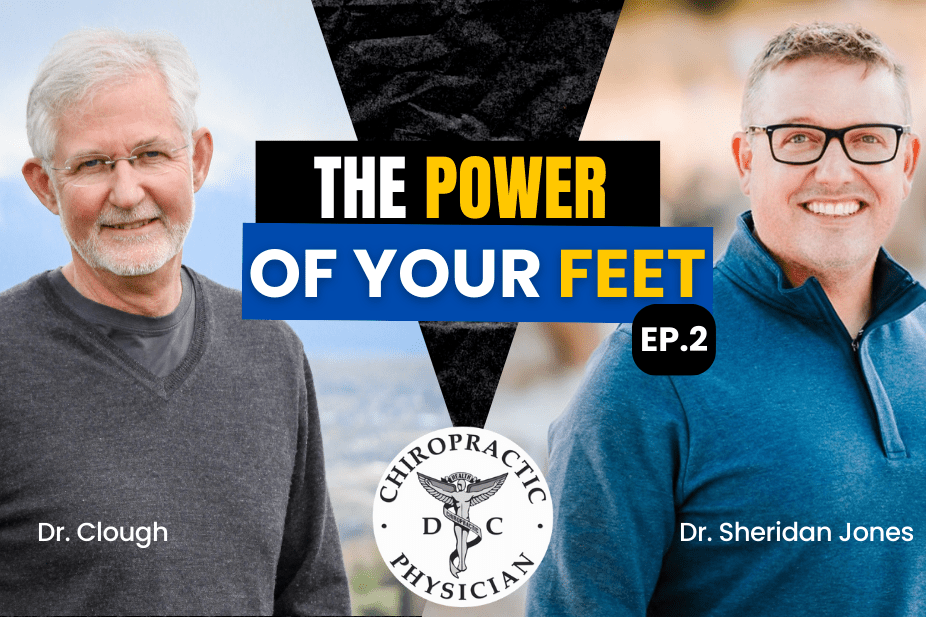
In this conversation, Dr. Jim Clough interviews Dr. Sheridan Jones, a chiropractor specializing in athletic performance. They discuss the importance of chiropractic care in sports, the effectiveness of the Cluffy insoles in treating foot disorders, and the holistic approach to patient care that considers the entire body. Dr. Jones shares insights on how foot health can impact overall athletic performance and the significance of addressing underlying issues to enhance recovery and prevent injuries.
00:00 Introduction and Credentials
00:19 Overview of Active Release Technique (ART)
04:37 Discovery of the Cluffy Wedge 06:49 Benefits of the Cluffy Wedge and Insoles
07:38 Screening Patients and Recommending the Cluffy Wedge
09:15 High Percentage of Patients Benefiting from the Cluffy Wedge
12:01 Enhancing Athlete Performance
12:34 Minimizing Concussions and TBIs
14:49 Consultations with Dr. Jones
Dr. Clough (00:00)
I’m Dr. Jim Clough and we’re on the podcast entitled The Power of the Feet. We have the privilege of talking to Dr. Sheridan Jones. He’s a chiropractic physician in Helena, Montana at Align Chiropractic Clinic. And Dr. Jones, I went on your website and you have a lot of credentials.
You are an amazingly well -trained chiropractic physician. I have been trained in lower extremity ART and I know what’s involved with that program. But for our listeners, can you explain what that is? And you’re full body certified in ART, which is quite an accomplishment.
Sheridan Jones DC (00:40)
Yeah, sure. I mean, that’s kind of a good segue because that’s honestly how I stumbled onto the Cluffy Wedge initially and then eventually the Insole. ART stands for Active Release Technique. And one of their taglines is simply the best soft tissue treatment.
They’ve done a tremendous amount of research to back up what they do as far as their protocols for treating different conditions and tissues. But basically, what we are trying to do is get to the root cause of any neuromuscular skeletal disorder, find that tissue that is actually problematic, and address that tissue directly. We’re in Montana, right? So sometimes firearms are easy way to describe things. So instead of using a shotgun, we’re using a sniper rifle. We’re getting right to the root cause. And I use it a lot in conjunction with the functional movement systems, selective functional movement analysis or SFMA.
Philosophy basically says to address what kind of problem this is, whether it’s a stability or mobility problem, and we attack it with the right kind of correction based on what category or bucket that it sits in. So utilizing SFMA analysis there and then applying a lot of active release techniques.
That’s kind of what I do all day, every day. Some of the other things that I do with the Titleist Performance Institute, they really use the selective functional movement analysis for creating the body swing connection. So even though I’m maybe in a little more of a golfer hat at that treatment, if you will, I’m still using the same analysis and the same treatments a lot of the time that I’m using on just anyone who comes into the office.
Dr. Clough (02:48)
So you really incorporate a lot of these very advanced techniques to identify problems in the body with lack of mobility or too much mobility. And then you’re addressing that specifically with active release technique, mainly in your treatments.
Sheridan Jones DC (03:06)
Yep, yeah, absolutely. And it’s, you know, I’ve kind of continued to learn more even if I’m at a different type of seminar. You kind of get to the realization that, you know, when these people are good and they know what they’re talking about, we all might be saying the same thing differently, you know, where the,I think, the best of the best and when it comes to physical medicine.
They have a real good understanding of why things are happening. They may describe it a little bit differently when you get into some of the different, you know, schools, you know, whether it’s, you know, dynamic neuromuscular stabilization or, you know, some of the other offshoots of, you know, treatment and stuff. But really they, you know, all have a great understanding of human movement and how we, you know, as providers need to restore that human movement in order to have a successful treatment of the patient.
Dr. Clough (04:10)
Yeah. Yeah. So I, you know, as a podiatrist, I went ahead and did the lower extremity ART and I was surprised at how involved that is. And you’re required, I think, yearly to become re -certified or updated on that. Is that correct? So it’s quite a commitment and talking to the leaders in the field about differences and what’s changing in that. Staying abreast to the latest techniques then. That’s great.
So when did you become aware of the Cluffy insoles and the Cluffy wedge?
Sheridan Jones DC (04:44)
The Cluffy Wedge, I’m thinking is probably right around 2021 or so. 2021 or somewhere in there. I was in Great Falls at our mutual colleague, Dr. Stobe’s office for training with ART and we were doing the lower extremity.
As we were working on different intrinsic muscles of the foot and lower limb, we identified multiple members in the classroom that had dysfunctional first ray. And so that was, he threw them in the shoes and stuff like that. So that was what kind of got me going down that rabbit hole. At that time I was at a different office, but I was fairly soon to open up my own clinic. And as soon as we opened up our clinic, that’s when I really put them into place for all my patients that are candidates, which there’s a vast majority that are. And I mean, it’s been a huge success. It’s easily the easiest insole with the best benefit that I’ve given to people. I mean, at our old clinic we had some, you know, Dannenbergs and Superfeet and different things like that. Back in the day I used to do the foot levelers thing. I’ve had some that I’ve sent in and they got casted. And I mean, just, you know, the only one that ever came, you know…close was one that I had another physical therapist cast an individual that did really well when I started doing balance tests and stuff like that. But I asked him, you know, what’d you pay for this? And, you know, it was close to $1,000 once it’s all done. So, you know, it’s not really even comparing apples to oranges at that stage.
Dr. Clough (06:49)
How many people, what do you think your percentage of people is coming in that have a foot disorder of the patients you see, Dr. Jones?
Sheridan Jones DC (07:00)
I’ve gotten to the point where I will screen everybody. I mean, my first thing that I’m doing when I’m seeing a patient is I’m screening them with SFMA chiefly there. But then as I break out into more special testing and stuff, I look at that first ray. And especially if I got anybody that they fail a deep squat or they fail a single leg balance, any of those things. That’s my immediate thought is like, I’m gonna be putting these people in Cluffies by the end of the day. So as far as.
Dr. Clough (07:39)
How do you tell your patients about the insole? How do you present that to them when you’re giving it to them?
Sheridan Jones DC (07:45)
I basically describe it as instead of providing an artificial support, we’re going to get something to make your endogenous stabilization system in your foot work there. And that’s going to stabilize your, you know, your entire, you know, body really. If you have a knee problem, a pelvic problem there, even, you know, going up into a spinal or cervical problem.
You know, if you start on a bad foundation, I think that’s just setting yourself up for failure. So what I usually do is I screen them. I check the dorsal flexion of the foot. And then I check the dorsal flexion when it’s loaded of that first ray. And I mean, there’s a high percentage of them that have bilateral but unilateral restrictions. I typically put them in the Cluffies because I’ll do a balance test or something on them and they see how much improvement they have. And they’re like, well, I wanna do both. So that’s our practice there, and we have two chiropractors and massage therapists right now.
I can add another provider here shortly. But there’s 60, 65 % of those total patients that are in Cluffies.
Dr. Clough (09:15)
Wow. And how are you finding that they work? I mean, if you have somebody with foot problems, it’s an obvious answer to most of those, but how are you finding that they work for some of your other problems you mentioned? You use it really holistically with your SFMA evaluation to try to improve mobility. So these are helping with different conditions other than foot problems, I’m assuming, right?
Sheridan Jones DC (09:44)
Yeah, I mean, especially like this time of year, we see a ton of kind of patellofemoral people there. It’s nice, they’re out trying to be weekend warriors, doing a Spartan race or something like that, and they come in with, you know, tearing knee pain. So that’s kind of my first line there. I do a single leg squat evaluation, functional evaluation with all my athletes. It’s kind of funny, it’s the end of the school year, but I’m doing a bunch of pre -participation physicals for high school kids. And these big strong athletes, they’re failing all over the place in their single leg squat and you get them, start evaluation. It’s like, well, yeah. You know, not only do your hip abductors suck, but your foot sucks. So we need to address both. So, and I usually kind of tell people that, you know, it’s like, you know, sometimes that reductionist type thing there, you know, has kind of plagued us there. I want to get to the exact problem, but I want to treat, you know, I want to treat everything.
Sheridan Jones DC (11:03)
The nice thing about this is that this allows me to do a lot of things that would take more time traditionally than now I can do some ART on the individual. I can put them in Cluffies and they have really good results. Some people if they want to really work on performance type stuff there, I might do some other type of stuff that like Tom Machat has kind of spoke about and different things, but just strengthening the foot. I think the Cluffy is a great kind of way to get in the door with that. I mean, literally if they’re walking purposely in good footwear with the Cluffies, they’re going to be exercising, you know, and using that windlass mechanism throughout the day, and really kind of retraining everything from the ground up.
Dr. Clough (12:01)
wondered if you had had a chance, Dr. Jones, to try this with any different athletes and notice any performance improvements or feedback from them regarding the insult.
Sheridan Jones DC (12:14)
yeah, we’ve had lots of collegiate football players, had a collegiate basketball player, trying to break into the collegiate cheer because just off of the work that you’ve done with the University of Montana cheer squad, it’s been a really, you know, I think it would be a hugely beneficial thing for these people, especially when you look at some of the incident rates of TBIs with females. I don’t have it right in front of me, but I want to say cheer is like top five as far as the incident of concussion and TBIs. So if we can do anything to help minimize those through more stability, better balance and stuff like that. I think that’d be a great thing, not for just their performance, but for the ability for them to stay in the game longer without injury. Golf is obviously my thing that I have the most experience with. So, that’s where I implement these insoles mostly. Most of those individuals notice, you know, less fatigue after rounds. you know, some will relate better club head speed. but, they just feel so much better. And I mean, especially if I get a golfer that’s, you know, having some sort of like plantar fasciitis or some sort of Achilles tendinopathy, they can’t believe it. I mean, most of those people are, you know, the first day you put them in, they come back and they’re like, you know, they wouldn’t even believe it if you told them, you know. If they didn’t experience it, they would never believe it.
Dr. Clough (14:06)
Excellent. Good to hear. Well, Dr. Jones, thank you very much for being with us today. We appreciate your time. Would you give us, would you give the listeners your contact information if they want to call you to see you for a consultation? Would you be able to do that?
Sheridan Jones DC (14:25)
Absolutely. Yes. So we have a fairly easy online booking platform at our website, which is alignhelena .com. Our phone number is 406-513 -1403. And you can email me directly. It’s drjones@alignhelena.com.
Sheridan Jones DC (14:49)
Definitely we’ll get you hooked up with all of our expertise and we always carry every size of Cluffy that’s available. So we can always get you hooked up there too.
Dr. Clough (15:04)
Dr. Jones, appreciate all the care you’re providing for people. You’re doing a wonderful job. Thank you very much for your time today. So we’ll look forward to talking to you again sometime, okay?
Sheridan Jones DC (15:14)
Yeah, I appreciate it, Jim. Thank you so much.








Share: