

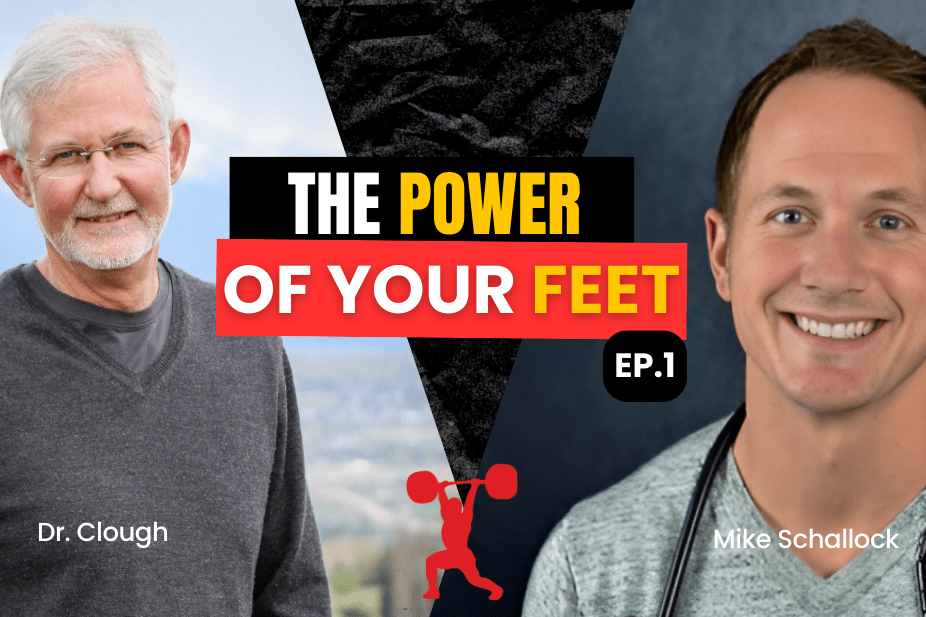
In this episode of the Power of Your Feet podcast, Dr. Jim Clough interviews Mike Schallock, a physician assistant with a strong background in fitness. They discuss the importance of fitness for health, the benefits of Cluffy insoles, and the significant improvements in athletic performance observed during testing. Mike shares his personal experiences with fitness and the positive impact of the insoles on both his and his wife’s athletic performance and injury prevention.
00:00 Introduction and Background
01:17 Mike’s Extensive Background in Fitness
03:49 Fitness Training at Every Age
05:10 The Benefits of Insoles
06:38 Improvements in Strength and Stability
08:24 Positive Impact on Knee Injuries
09:14 Recommendation and Contact Information
Dr. Clough (00:02)
Hi, I’m Dr. Jim Clough and today we have the privilege of talking to Mike Schallock. Mike is a physician assistant that I’ve had the privilege of working with at St. Luke’s Health Care for the last seven years. And recently we tested Mike for some fitness testing. So today we’re going to talk to him about his fitness, what he does and so forth. So Mike, you are a PA with St. Luke Health Care in family practice.
Mike Schallock (00:31)
Mm -hmm.
Dr. Clough (00:32)
And you, you’ve been voted best physician in Polson for a couple of years, I believe, right?
Mike Schallock (00:40)
I think a couple years, yes. So a few years anyways, two or three I believe.
Dr. Clough (00:46)
Wonderful. And you’re a pastor of Mission Church here in Polsen, correct? Yeah. Yeah. So Mike, what is your background in fitness?
Mike Schallock (00:51)
That’s correct. I do that on the side.
I have a pretty extensive background in fitness, kind of stemming from collegiate athlete days. I became an A certified personal trainer, eventually went on to become a CrossFit certified personal trainer. I actively participate in all sorts of activities, including collegiate running when I was in the college setting, as well as continued running in my post -college years. Further to that, I do a lot of CrossFit training, Olympic weightlifting on a regular basis,
five to six days a week typically. And that’s done both in a gym setting and then also at home. So a lot of different modalities within the exercise community that I like to do.
Dr. Clough (01:40)
Okay, great. So why did you start with fitness training?
Mike Schallock (01:49)
You know, I just enjoyed, I’ve always enjoyed physical activity, again, stemming back to kind of high school and college athletics. I really enjoyed just kind of getting to see what you can do with your body, see how you can test your body, see how you can improve yourself, you know, physically, mentally, all the above. So I just, something that I think I have become kind of a lifelong fitness addict and something that I still just enjoy both from a personal wellbeing standpoint and stress relief, as well as just kind of enjoy the athleticism within all these different opportunities that we have around Western Montana to be outside and exercise and do lots of great things.
Dr. Clough (02:29)
So as a PA, Mike, what do you know about the health benefits of fitness?
Mike Schallock (02:34)
A lot. I have spent a tremendous amount of my own personal time in education to become proficient in understanding exercise physiology and also understanding exercise science as a whole. So I have a pretty extensive background with that. Really a lot of it has been, you know, on my own within the medical school model, which is the same as the PA school model, very small fraction of our training is given towards exercise, nutrition, education. So a lot of that has been independent.
So for me, most of that has been through different programs that I have sought out just again from personal expertise. And then also just doing it, CrossFit’s something where I became an active coach and coached in the gym for a few years. Again, did personal training back in my college days. And then other than that, just a lot of trial and error with exercise, but kind of understanding how that impacts our whole health and fights chronic disease.
You know, everything from managing heart disease to diabetes, which is what I do in my day -to -day job, you know, looking at the health benefits for managing things like, you know, high lipids, high blood pressure, all of those types of problems that we see day -to -day in family practice. This is something that I don’t just, you know, preach, I actually practice, so.
Dr. Clough (03:49)
Seems like there’s more and more benefits that we’re realizing with fitness activities. Isn’t it? Yeah. It’s amazing. It’s a great, great medicine. When should somebody start to train with fitness and do the kind of thing you do? Is there a lower age limit on when you would recommend doing that?
Mike Schallock (03:53)
You know, I don’t think there per se is a lower age limit. I honestly think it’s one of these things where, you know, the sooner we can kind of educate our children at a younger age and get them involved with physical activity, the better. You know, I think some things such as, you know, higher intensity weight training, those activities should wait till skeletal maturity. But I think for the majority of, you know, kids and adults, there really is no age limit with which we should be exercising. So it should be a lifelong endeavor.
Dr. Clough (04:34)
What about lifelong?
So even older people should be doing this. There’s no way, there is no limit on the upper end?
Mike Schallock (04:37)
Not at all. I see inactivity as probably the greatest killer in my job. That’s where many people retire and then they either just don’t make time or kind of lose interest in physical activity and specifically organized exercise. And the old adage that if you don’t use it, you lose it is really true. And the older we get, the more true that is.
Dr. Clough (05:07)
Great. Mike, I did some testing with you probably about four weeks ago, five weeks ago with the Cluffy insoles. And when we went out to do the testing, I noticed that you had a carbon fiber insole in your shoes. And we actually tested you with that carbon fiber insole initially. Why were you wearing the insoles in your shoes?
Mike Schallock (05:32)
You know, I initially started wearing more arch support insoles predominantly just to improve my form and kind of foot function and technique. It was something that I just kind of personally had done some trial and error with and found that my feet felt a lot more comfortable with those. I didn’t get foot fatigue with exercises such as running or hiking and just noted, you know, better support of my foot overall. So that kind of translated into a better athletic experience.
Dr. Clough (05:59)
Okay, and then we tested you with the Cluffy insoles and what did you notice when we did that?
Mike Schallock (06:08)
It was unbelievably different in a good way. It was amazing to see how much more stable my foot felt, how much more supported my foot felt, and then just in the real practical application of balance and then balance under weight, it was phenomenally better. It was an instant and immediate change that I noticed in my foot and also in my athletic performance.
Dr. Clough (06:33)
Yeah. And one of the things that I was surprised with, and you were one of the first people we tested, you and your wife, I think you were the first two people that I tested with weights and fitness and balance and so forth. But we tested your strength in your upper extremity. And I’m looking at your results here and with your bicep strength test, we had you basically holding your, your arms straight out, like at 90 degrees, your elbow bent at 90 degrees. And I’m pulling down on your forearm to see how much stress you could resist before you broke that position. And you went from 74 .9 pounds to 93 .1 pounds with the insole. That’s a gain of almost 20 pounds. Were you surprised by that?
Mike Schallock (07:26)
I was extremely surprised. I was honestly kind of dumbfounded at how big the difference was, not just in that one position, but pretty much in all the positions that we tested and tried. The weight percentages that I was able to hold under stress and balance were dramatically improved, I mean, across the board. So yeah, I was extremely surprised, but also very pleased.
Dr. Clough (07:50)
And one of the things that I found interesting is when we put you in the lunge position and we’re testing your knee stability moving inward and outward, there was an improvement in your stability when we pushed your knee inward. Do you think that would have any implications for knee injuries or anything like that when you’re training?
Mike Schallock (08:13)
Absolutely, I mean you look at any sport that involves you know kind of deep knee bending which could be anything from you know track to soccer, skiing for another example, any of those types of activities where…
Mike Schallock (08:32)
it’s trending and pushing inwards, that increased degree of stability to me translates in a significantly reduced risk of having a knee injury. And I see that in the athletes that I see and treat every day.
Dr. Clough (08:46)
And your wife was having some problems, mechanically as well. We put her in the insoles. I haven’t been able to follow up with your wife, but would you be able to comment? Has she seen any improvements with the insoles?
Mike Schallock (09:00)
Yeah,she’s actually had tremendous improvement in her knee pain. She’s somebody who has pretty significant limited range of motion in her ankles, which in turn has translated into a lot of reduction in her ability to move through a biomechanics process properly with her knee. So she had kind of chronic issues with both knee and ankle pain, particularly with deep lunging and deep squatting. Both of those within the last four weeks have pretty much completely gone away, which has been an amazing improvement. This is something she’s struggled with for years. So we have been absolutely blown away by the Cluffy Insole.
Dr. Cloughjim (09:36)
It’s good to hear. It’s encouraging. Thank you. So Mike, to sum it up, what would you say to other fitness athletes? Would you recommend the Insole to them and why would you recommend it for them?
Mike Schallock (09:49)
I would 100 % recommend the insole pretty much across the board for anyone who’s involved in any type of athletics. My opinion, and not only just my opinion, but the real world application that I’ve seen is this tremendously improves your stability, tremendously improves your positioning, your posture. It universally has improved my athletic performance in all of my Olympic weightlifting. And you just feel better as far as your feet, your knees, your legs, your hips.
It’s amazing how the insole, unlike any other insole that I’ve tried, and I’ve tried many, has actually made a bigger difference in my overall biomechanics than anything across the board that I’ve ever done.
Dr. Clough (10:30)
Thank you, Mike. That’s good to hear. Well, that’s all the questions I had today, Mike, for you. Could you provide your contact information for the listeners if they want to contact you as a PA or, you know, for ongoing health care?
Mike Schallock (10:46)
Yeah, absolutely. My contact is mschallock at gmail .com. And that is a good email that you guys can use to contact me. The other email is mschallock, same spelling, at stlukehealthcare .org
Those would be either good ways to get a hold of me. As a health professional, I would love to talk with other health professionals about this. This is not a gimmick. This is not just another insole. This is something that has been tremendously game changing more than I ever expected. And I’ve just been really pleased and honored to get to participate in some of the trial and testing for it. So thank you, Dr. Clough.
Dr. Clough (11:33)
Thank you, Mike. We appreciate your time today as well. Thank you very much. Take care.
Mike Schallock (11:37)
All right. Thank you. Have a great day..







Share: